Surviving Ultra

Because DFL is still an accomplishment

Blog

  • NJ Spartan Ultra

    I had registered for the NJ Spartan Ultra about 6 months ago as this particular ultra was the first ultra I ever ran and what sparked my interest in ultrarunning.  It was something I had eventually wanted to repeat as a way of gauging my progress and proving to myself that I wasn’t just lucky getting through it the first time. Still, I was on the fence about running this particular race this year as I felt my training was going well and I was unsure about losing momentum with the progress I had been making.  I had some friends also running the race though and didn’t want to let my team down, so I decided to take a bit of break from the MTI program I was 2 weeks into and give it a shot. 

    The course had a different configuration from what I remember from past years’ Beast races and the past Ultra I had done.  According to the elevation map, the course featured almost 12K of elevation gain over the length of the 30-mile race.  It was a tougher layout than what I remember and one that will set my training back by at least a week or two while I recover from it.  Nevertheless, I’m glad I gave the race a shot.  It was the first time I have raced an ultra where I managed to not be in the back of the pack squeaking by the cutoffs.  I passed the cutoffs with a comfortable margin and even though the race was extremely challenging I did not find myself questioning if I was going to make it to the next checkpoint in time at any point in the race.  While some of the improvement can be attributed to having a better idea on how to pace myself from past races and from having some experience with keeping hydration and nutrition in check, my training over the last year has definitely had a positive impact.  The race let me know that I am on the right track and my performance in it makes me feel my 50-mile goal is an achievable goal if I continue to put the work in.  In particular I think all of the rucking up hills, dumbbell step-ups, and Bulgarian split squats that were part of the strength programs I ran had a noticeable effect, especially combined with the fact that the vast majority of my recent running had been on hilly terrain.  The ascents were not easy and sometimes very slow, but nevertheless never seemed insurmountable.  

    Time to rest up and heal for a little bit before getting back to it.
  • MTI – Max Effort Strength + 6 Mile Run

    While I enjoyed the Tactical Barbell Base Building block, I have also long wanted to try a program from Mountain Tactical Institute (MTI).  MTI offers a plethora of different programs designed to meet a variety of different goals, including some running programs which scale to 50 miles.  As such, I could theoretically reach my strength and 50 mile distance goals using solely programs from MTI, which is what landed them on my radar of programs to consider.  Given I want to spend a few more weeks without any major increases to my miles per week (to ensure all knee issues remain behind me), it seemed like a good time to try one of their programs with a similar goal set to my prior base building block.

    The 6 week Max Effort Strength + 6 Mile Run program consists of 2 days of total body strength training combined with 3 days of running.  For this block I will be putting the rucking I used to improve my ability to climb hills aside and running on all 3 running days.  This will result in a small increase in running mileage for me.  More interestingly, the program incorporates some interval runs as well as zone 2 runs and I’m hoping the intervals provide some additional speed improvements for me.

    At first glance the program is higher in intensity than the Tactical Barbell block, using higher max percentages and shorter rest times on lifts, which makes the lifting portions more closely resemble the approach used in many of the strength programs I have done in past. I also really like how it integrates warm-up, core, and mobility exercise into each day’s workout.  Now it’s time to see how my body responds to the different intensity approach when paired with a structured running program (something I neglected for too long).

  • Base Building Finishing Thoughts

    I just finished the last workout of the Tactical Barbell base building phase and I really enjoyed the program.  It was a great way to get myself back onto a structured running program while still continuing to incorporate strength training into the mix. My per mile times have improved over the course of the two months and I think the program was ideal for building a foundation off of which to build on in future blocks.  After a couple of weeks of religiously incorporating the couch stretch and some of the other correctives, my knees are feeling better when running downhill too.  The program and the progress I made has helped me rediscover some of the passion that first got me into running many years ago and I am excited to start my next training block. 

    The most interesting discovery for me, however, was the two day a week Fighter strength template that the base building block makes use of.  It’s a minimalistic template that is designed to be submaximal in order to allow it to be paired with intense conditioning activities.  While minimalistic, however, it’s a template I can still see myself making slow but steady progress with.  While I haven’t retested my maxes yet, the RPE for the weights I was using definitely became easier than it was for the same weight before my base building phase.  While I admit that I did give into the temptation to add some accessory work in the form of dips and chin-ups on some of the workouts, I really liked the submaximal concept.  As miles per week levels begin in increase and the training gets harder to recover from a result, I think the Fighter template will be nice tool in my arsenal to maintain strength. Now onto my next training block which I will detail in my next post.

  • Running Correctives

    With any endurance sport there is always a risk for overuse injuries and injury prevention is critical as nothing will impact training for an event more than not being able to do it because of an injury. Doing a few thousand feet of downhills each week has the potential to become such an overuse injury for me.  I’ve been more conscious of my form and have tried to make a conscious effort to always maintain good posture and to lessen the amount I sit which has helped, but there is always room to do more. Because of my success with alleviating some issues after reading Deskbound, I decided to check out Ready to Run which is also by Kelly Starret.  It provides a series of 12 recommendations to help keep runners injury free and improve longevity in the sport.  Many of the recommendations are simple to implement such as drinking more electrolytes to improve hydration or wearing zero drop shoes while others touch on warm up and mobility routines to address common running problems.  While some recommendations I already touch on (e.g. the couch stretch), I have not been doing them with the daily frequency recommended in the book. 

    I’m going to start incorporating the recommendations in this book into my daily routine and finish out my last 2 weeks of the Tactical Barbell base building program. Once the base building phase wraps up, I intend to continue giving the recommendations in the book a try over the next couple of months but will probably put a temporary freeze on any major mileage increases until I give my body time to properly adjust to the downhill volume.  I will be picking a 10K or half marathon program with similar weekly mileages to what I am already doing and working on running those miles in an issue free manner.  I will be pairing this program with a strength program so I can continue to make improvements in that area as well. 

  • Too Many Hills???

    While having easy access to steep hills can be a great thing for an ultrarunner, I’m learning it can have its downsides as well.  Roads and trails that I am able to run regularly average about 250 ft of elevation gain every mile. It’s great that my new base building phase has me consistently running again and I have made some nice improvements to my aerobic base as well as improvements in the “mountain legs” department.  Doing a few thousand feet of elevation gain each week has made my ability to go up hills noticeably better.  I’ve also made some improvements on the downhills as well.  Downhill running was always a weak point for me (still is).  I tend to break too much and not lean forward enough, which is something I am getting better at but still need to improve.  My quad endurance has also improved greatly and I don’t find myself with destroyed quads anymore after a lot of downhill running.  This is all great and has allowed me to push longer and farther, but as my distances are increasing, I’m noticing the increased downhill efforts are starting to lead to some soreness in the knees. While “too many hills” is a good problem to have for an ultrarunner, it does mean that I may have to be more conservative about how I build up the distance and that I may need to incorporate some corrective exercises into my programming.

    I was originally thinking of moving onto the Tactical Barbell Green Protocol book which builds you up to running ultra-distances, with concurrent strength training, as my next step, but I may opt to first cap the distance I am running and focus on improving my downhill form (and speed on uphills and flats) so I can keep running consistently and avoid injury when I eventually do make further increases in distance.  With 3 successful 50Ks in the bank, it’s no longer a matter of can I do the distance, but how can I do it better so I can eventually scale to 50 miles.  Slowing down a bit on running distance progressions to correct a problem, while still being a more consistent runner than I was with training for my previous races, will still be a win and Green Protocol will still be there waiting for me in a couple of months. 

  • Base Building SE Phase Progress

    Stopwatch

    I’ve completed the first phase of a Tactical Barbell Base Building block and am just about to finish week 5.  While I still have another 3 weeks to go, I figured the conclusion of the SE phase was a good time to assess my progress so far.  I am seeing improvements in the pace I am able to maintain while still remaining in zone 2 and more importantly it’s given me a structured way to incorporate running alongside strength training, which is where my training was lacking and what I was looking for in a program.  Its schedule has helped me become a more consistent runner which in the near term is where my biggest gains will come from.

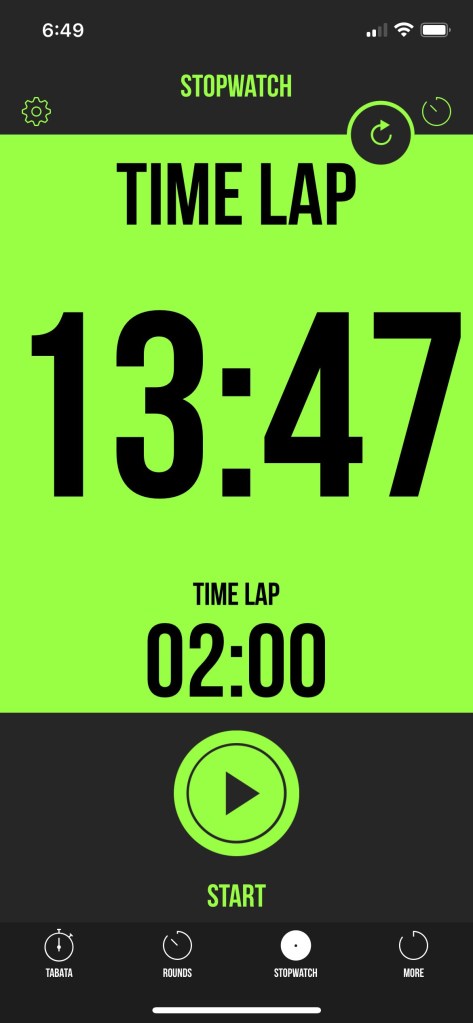
    I also like to periodically test myself by running a burpee ladder for time.  I was able to complete a baker’s dozen burpee ladder in both directions in 13:47 which is just over a minute better than a previous attempt of 14:58. The baker’s dozen burpee ladder involves performing 13 burpees walking back and forth 8 feet and then performing a similar round with 12 burpees.  The walk is then repeated and the burpee count decremented by 1.  This process is repeated until a single burpee round is reached.  At that point a round with a single burpee is repeated and the count incremented back up until a round with 13 burpees is completed.  While credit for this improvement cannot completely be attributed to the base building phase (I also ran AthleanX’s Anabolix and Train like Bane programs since I last tested) the SE phase definitely helped further add to work capacity. 

    I am looking forward to the next 3 weeks of max strength and future training blocks leveraging this system.

  • Running for Time vs Distance

    At this point I’m about half way through the Tactical Barbell Base Building phase and one of the things about the program that I have never rigorously tried in a training phase before was implementing the concept of running for a set amount of time vs a set amount of distance. I always went out for runs with the idea of completing a certain route or a certain number of laps and not a time goal.  While I know phases that involve distance are essential at some point, I really like the concept of running for time as part of a phase geared around building an aerobic base.  Building an aerobic base is largely centered around performing runs (or other cardio) for a minimum of 30 minutes in zone 2 (although I set longer time goals).

    At least for me, having a time goal seems to make it psychologically easier to stick to zone 2 even if it means slowing down on or walking up a particularly steep hill.  The goal is to maximize time in zone 2 and this takes away the inherent pressure to try to perform better than I did at a previous attempt of the same distance which can drive heart rate into higher zones.

    The best part is the adage run slow to run fast really does work.  While I still have a lot of room for improvement, I am seeing improvements in my per mile time after the first month of this block and I am looking forward to seeing more improvements over the 2nd month and in future training blocks. I think in the past I often ran too fast, and spent too much time in higher heart rate zones to see this benefit.

  • Burpee Ladders

    While trail running tends to be a largely aerobic activity and burpees can rapidly turn into an anaerobic one, being introduced to ultrarunning through Spartan races, you can’t help but form a love/hate relationship with the burpee.  Burpees feature prominently not only in Spartan inspired workouts, but also as penalties for failing an obstacle (although penalty loops have become more common in recent years).  Burpees have long been a staple of my training and burpee ladders in particular are a go to when looking for an intense HIIT workout. Burpees are something I find:

    1. Help build explosive power – The quick transitions between positions and the full body muscle engagement makes burpees a great way to train explosivity, which as a Spartan racer can help you power your way over an obstacle.  As a trail runner they can help you power your way up a particularly steep section of the trail.
    2. Mental Toughness – Burpees rapidly get challenging. Just like the ultra saying “run the first half with your legs, the second half with your mind”, completing a burpee ladder can often turn into a mental game.  They are a great way to prove to yourself that you can endure.
    3. Can be mixed with hill sprints  – Mixing alternating rounds of burpees and hill sprints forms a killer workout.  For example, do a set of burpees and then sprint up a hill, walk down, and repeat. 
    4. Can be done indoors with limited space – We all have days when we can’t go outside or get to a gym.  Burpees require no equipment and very limited space allowing for an intense workout almost anywhere.

    For some interesting ideas on burpee ladders and burpee variations I found the Jailhouse Strong book Josh Bryant and Adam benShea worthwhile.  I liked the different burpee ladder options that it offered such as the Baker’s Dozen and the Prisoner Burpee Challenge, but what I really liked is that it did not just provide the workout but target times for different levels of fitness.  While progress can always be assessed by I ran faster or I lifted more, sometimes it’s nice to see how your time stacks up against a standard as a goal of beating or exceeding a certain standard can be motivational.

  • Rucking Cross Training

    When I laid out the Base Building Phase that I am currently running, I mentioned that one of my zone 2 cardio activities was going to be a hilly ruck with a 40 pound vest.  Rucking for ultramarathon prep seems to be a topic that elicits very mixed reviews when you search for opinions on it with some saying it has helped them and others saying the time would be better off spent running.  I think it is a bit more nuanced than “it’s great, everyone should do it” or “it’s a waste of time, just run”.  Here is my rationale for using rucking as a cross training activity and why I think it benefits me.

    Elevation Gain Differences – While I have access to some decent sized hills, sometimes the races I like to run are often in locations that have steeper elevation profiles than I can run on a day to day basis.  I find rucking up the hills I have access to a great way to build the “mountain legs” required to get myself up those steeper race day climbs.  To me it’s the same principle as using an ultra-training program where they have you perform a prolonged period of dumbbell step ups to strengthen and build endurance in your legs, only less monotonous. While I do think there are advantages to dumbbell step ups and do incorporate them in some training blocks, rucking, for me, is a way to gain a similar benefit while getting to explore someplace interesting.

    Not a World Class Runner – One of the common arguments against rucking is xyz champion doesn’t do it.  I think being realistic about where you stand is important though.  A championship runner maybe can run the entirety or at least the majority of their race, but that is not the case for me.  If I’m realistic with myself, I have to admit that there are going to be significant parts of a race where I will probably need to switch from running to power hiking. These parts are significant enough that there is benefit to training the power hiking component as a way of improving my completion time. While it’s hard to say for certain if it has made me a faster runner, it has definitely helped to improve my hiking speed which is a win for my current ability level.

    Lower Impact – For me personally, I find it lower impact than running with the added benefit that it uses many of the same muscles as running but in slightly different way.  The slight difference seems to allow me to add in rucking as a cross training session each week without feeling like I am over training.  I don’t run with the added weight as that much too high impact, but stick to a power hike.

    Functional Core Strength – Rucking is also a great compliment to other core strengthening exercises and helps you build strength and muscle endurance in your core which helps with maintaining good form in the later stages of race. 

    Perhaps if I had everyday access to steep terrain and the time to build up to such a high weekly mileage that running the majority of an ultra was not a question, I would reconsider my approach.  However, as a frequent power hiker without daily access to race-like elevation profiles, rucking is working well for me as a cross training option.

  • Trap Bar Deadlifts for Ultrarunners?

    Deadlifts have been a part of my strength training routine for quite some time now, but for the longest time I performed them with a barbell and never gave any thought to trying a trap bar.  Prior to starting my current round of base-building I did a 3-month strength focused block where I gave a trap bar a try for the first time.  The idea to give it a try was largely inspired by a lot of the research compiled in this article on the trap bar authored for Stronger by Science:

    Trap Bar Deadlifts are Underrated

    While this is just my personal experience and therefore anecdotal, my experience was a positive one and I can see myself using the trap bar again in future training blocks.  For the duration of the block I used the trap bar in the low handle position to try to maximize the hinge effect.  I found that:

    1. Less fatigue: Deadlifting with the trap bar was less fatiguing for me.  Working out the day after a heavy deadlift session was always a bit of a challenge as I always felt a bit more fatigued than I would after any other type of strength session, which often impacted my desire to run the next day. When I switched to the trap bar, I felt I still solidly worked out my posterior chain but I did not feel the same level of post workout fatigue which allowed me to push harder on the next day’s work out.
    2. More forgiving of form: While properly positioning the spine and bracing your core is essential before any lift, the trap bar is a bit more forgiving if everything is not perfect.  This made me a little more comfortable challenging myself to get in the extra rep or two as even if my form degraded a bit because of tiredness, the same likelihood of injury was not there. I was a bit more comfortable pushing myself closer to form failure which in turn helped make for a better workout. 
    3. More quad activation: Given how quad destroying running downhill segments can be, I found this to be an added benefit and not a downside.  It turned the deadlift into a bit of an “accessory” exercise for the quadriceps which I feel has had a positive impact on running hills. 

    Given my experiences I plan to use the trap bar deadlift as my primary deadlift variation going forward, particularly for the months of the year where I will be more running focused as the lower level of fatigue is a major advantage. I will likely not abandon the straight bar deadlift entirely though.  I can see myself occasionally going back to it in strength focused blocks or if I hit a plateau with the trap bar to hit the muscles in a slightly different way.