Surviving Ultra

Because DFL is still an accomplishment

Tag: marathon

  • Pocantico Hills Marathon

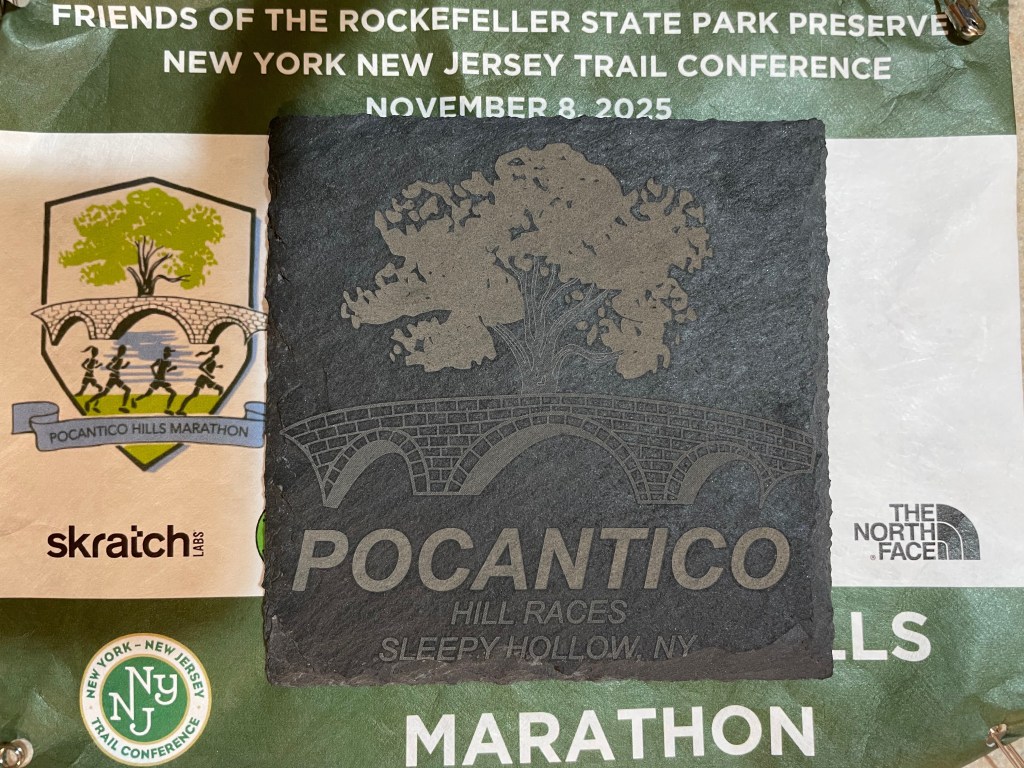
    The Pocantico Hills Marathon is a trail marathon held in the very scenic Rockefeller State Park Preserve and it just celebrated it’s 5th year. This is my second time running this marathon and one I see myself repeating again in the future.  It’s a marathon that has a very generous cutoff that makes it feasible to hike the course if desired and is thus a great event for a first time attempt at a trail marathon.  The trails are gravel carriage roads with ~2500 feet of elevation gain over the course of the race. It’s a very runnable course. It’s a course I like so much that I took the gpx file from my Coros watch’s recording of the run and created a route in Komoot so I can run the course again in the future (https://www.komoot.com/tour/2678030551). It’s also the type of course I need to focus on more of as I tend to be more of mountain goat than a race horse.  I do really well in ultra’s that are very steep and technical (https://survivingultra.com/2025/04/28/nj-spartan-ultra/), but tend to be very slow at the flatter more runnable courses.

    While I was still towards the back of the pack in this event, I’m happy with my performance in the race as my training had been focused more on leaning out than running over the past few months and I had been in a caloric deficit up until a couple of days before the race.  My performance in the race showed I didn’t step backwards despite not being as focused on running recently and I feel I am well positioned now to start building towards completing a 50 miler over the course of the next year.  Of course, being back of the pack means there is a lot of work to do, but I think my now improved strength to bodyweight ratio has me well situated to start that buildup and eventually go faster and further than before. 

  • Getting Ready for the Next Challenge

    The Spartan Ultra from 2 weeks ago gave me the confidence that I am progressing and improving as an ultramarathoner and that my training is moving me in the right direction, as for the first time I was not struggling to make a cut off.  I suspect, however, part of why I did well was the steepness of the race and the fact that the cutoffs were designed around a course that hiking the majority of it was assumed.  I think I have developed a very high work capacity but that I still need to continue to improve as a runner.  I suspect that I would not have been anywhere near as close to the front of the pack if it had been a race with less elevation gain and more runnable terrain.  To test this, I have registered for a trail marathon in November that features an elevation gain of only around 2.5K feet.  While not flat, this is a course that will be significantly more runnable than my last race and will allow me to test my theory.  When I eventually put a 50 miler on the calendar I want to make sure to pick a course that will play to my particular strengths and weaknesses and so I want to put this to the test. 

    An early November race date gives me roughly six months to train for it and I intend to do so by following a true marathon prep program for the first time, albeit one that maintains an element of strength training.  Given the time I have to prepare for the race, I intend to pursue the following build up in prepping for the event:

    1. Finish the Mountain Tactical Institute (MTI) Max Effort Strength and 6 mile Run program that I’m currently running
    2. Move onto the MTI Max Effort Strength and Aerobic Base program
    3. End with the MTI Meathead Marathon plan which is designed to build more strength focused athletes up towards being able to run marathon distances. 

    If all goes well, I’m hoping be ready to run and not power hike the vast majority of the course. 

  • NJ Spartan Ultra

    I had registered for the NJ Spartan Ultra about 6 months ago as this particular ultra was the first ultra I ever ran and what sparked my interest in ultrarunning.  It was something I had eventually wanted to repeat as a way of gauging my progress and proving to myself that I wasn’t just lucky getting through it the first time. Still, I was on the fence about running this particular race this year as I felt my training was going well and I was unsure about losing momentum with the progress I had been making.  I had some friends also running the race though and didn’t want to let my team down, so I decided to take a bit of break from the MTI program I was 2 weeks into and give it a shot. 

    The course had a different configuration from what I remember from past years’ Beast races and the past Ultra I had done.  According to the elevation map, the course featured almost 12K of elevation gain over the length of the 30-mile race.  It was a tougher layout than what I remember and one that will set my training back by at least a week or two while I recover from it.  Nevertheless, I’m glad I gave the race a shot.  It was the first time I have raced an ultra where I managed to not be in the back of the pack squeaking by the cutoffs.  I passed the cutoffs with a comfortable margin and even though the race was extremely challenging I did not find myself questioning if I was going to make it to the next checkpoint in time at any point in the race.  While some of the improvement can be attributed to having a better idea on how to pace myself from past races and from having some experience with keeping hydration and nutrition in check, my training over the last year has definitely had a positive impact.  The race let me know that I am on the right track and my performance in it makes me feel my 50-mile goal is an achievable goal if I continue to put the work in.  In particular I think all of the rucking up hills, dumbbell step-ups, and Bulgarian split squats that were part of the strength programs I ran had a noticeable effect, especially combined with the fact that the vast majority of my recent running had been on hilly terrain.  The ascents were not easy and sometimes very slow, but nevertheless never seemed insurmountable.  

    Time to rest up and heal for a little bit before getting back to it.

  • Too Many Hills???

    While having easy access to steep hills can be a great thing for an ultrarunner, I’m learning it can have its downsides as well.  Roads and trails that I am able to run regularly average about 250 ft of elevation gain every mile. It’s great that my new base building phase has me consistently running again and I have made some nice improvements to my aerobic base as well as improvements in the “mountain legs” department.  Doing a few thousand feet of elevation gain each week has made my ability to go up hills noticeably better.  I’ve also made some improvements on the downhills as well.  Downhill running was always a weak point for me (still is).  I tend to break too much and not lean forward enough, which is something I am getting better at but still need to improve.  My quad endurance has also improved greatly and I don’t find myself with destroyed quads anymore after a lot of downhill running.  This is all great and has allowed me to push longer and farther, but as my distances are increasing, I’m noticing the increased downhill efforts are starting to lead to some soreness in the knees. While “too many hills” is a good problem to have for an ultrarunner, it does mean that I may have to be more conservative about how I build up the distance and that I may need to incorporate some corrective exercises into my programming.

    I was originally thinking of moving onto the Tactical Barbell Green Protocol book which builds you up to running ultra-distances, with concurrent strength training, as my next step, but I may opt to first cap the distance I am running and focus on improving my downhill form (and speed on uphills and flats) so I can keep running consistently and avoid injury when I eventually do make further increases in distance.  With 3 successful 50Ks in the bank, it’s no longer a matter of can I do the distance, but how can I do it better so I can eventually scale to 50 miles.  Slowing down a bit on running distance progressions to correct a problem, while still being a more consistent runner than I was with training for my previous races, will still be a win and Green Protocol will still be there waiting for me in a couple of months. 

  • Rucking Cross Training

    When I laid out the Base Building Phase that I am currently running, I mentioned that one of my zone 2 cardio activities was going to be a hilly ruck with a 40 pound vest.  Rucking for ultramarathon prep seems to be a topic that elicits very mixed reviews when you search for opinions on it with some saying it has helped them and others saying the time would be better off spent running.  I think it is a bit more nuanced than “it’s great, everyone should do it” or “it’s a waste of time, just run”.  Here is my rationale for using rucking as a cross training activity and why I think it benefits me.

    Elevation Gain Differences – While I have access to some decent sized hills, sometimes the races I like to run are often in locations that have steeper elevation profiles than I can run on a day to day basis.  I find rucking up the hills I have access to a great way to build the “mountain legs” required to get myself up those steeper race day climbs.  To me it’s the same principle as using an ultra-training program where they have you perform a prolonged period of dumbbell step ups to strengthen and build endurance in your legs, only less monotonous. While I do think there are advantages to dumbbell step ups and do incorporate them in some training blocks, rucking, for me, is a way to gain a similar benefit while getting to explore someplace interesting.

    Not a World Class Runner – One of the common arguments against rucking is xyz champion doesn’t do it.  I think being realistic about where you stand is important though.  A championship runner maybe can run the entirety or at least the majority of their race, but that is not the case for me.  If I’m realistic with myself, I have to admit that there are going to be significant parts of a race where I will probably need to switch from running to power hiking. These parts are significant enough that there is benefit to training the power hiking component as a way of improving my completion time. While it’s hard to say for certain if it has made me a faster runner, it has definitely helped to improve my hiking speed which is a win for my current ability level.

    Lower Impact – For me personally, I find it lower impact than running with the added benefit that it uses many of the same muscles as running but in slightly different way.  The slight difference seems to allow me to add in rucking as a cross training session each week without feeling like I am over training.  I don’t run with the added weight as that much too high impact, but stick to a power hike.

    Functional Core Strength – Rucking is also a great compliment to other core strengthening exercises and helps you build strength and muscle endurance in your core which helps with maintaining good form in the later stages of race. 

    Perhaps if I had everyday access to steep terrain and the time to build up to such a high weekly mileage that running the majority of an ultra was not a question, I would reconsider my approach.  However, as a frequent power hiker without daily access to race-like elevation profiles, rucking is working well for me as a cross training option.